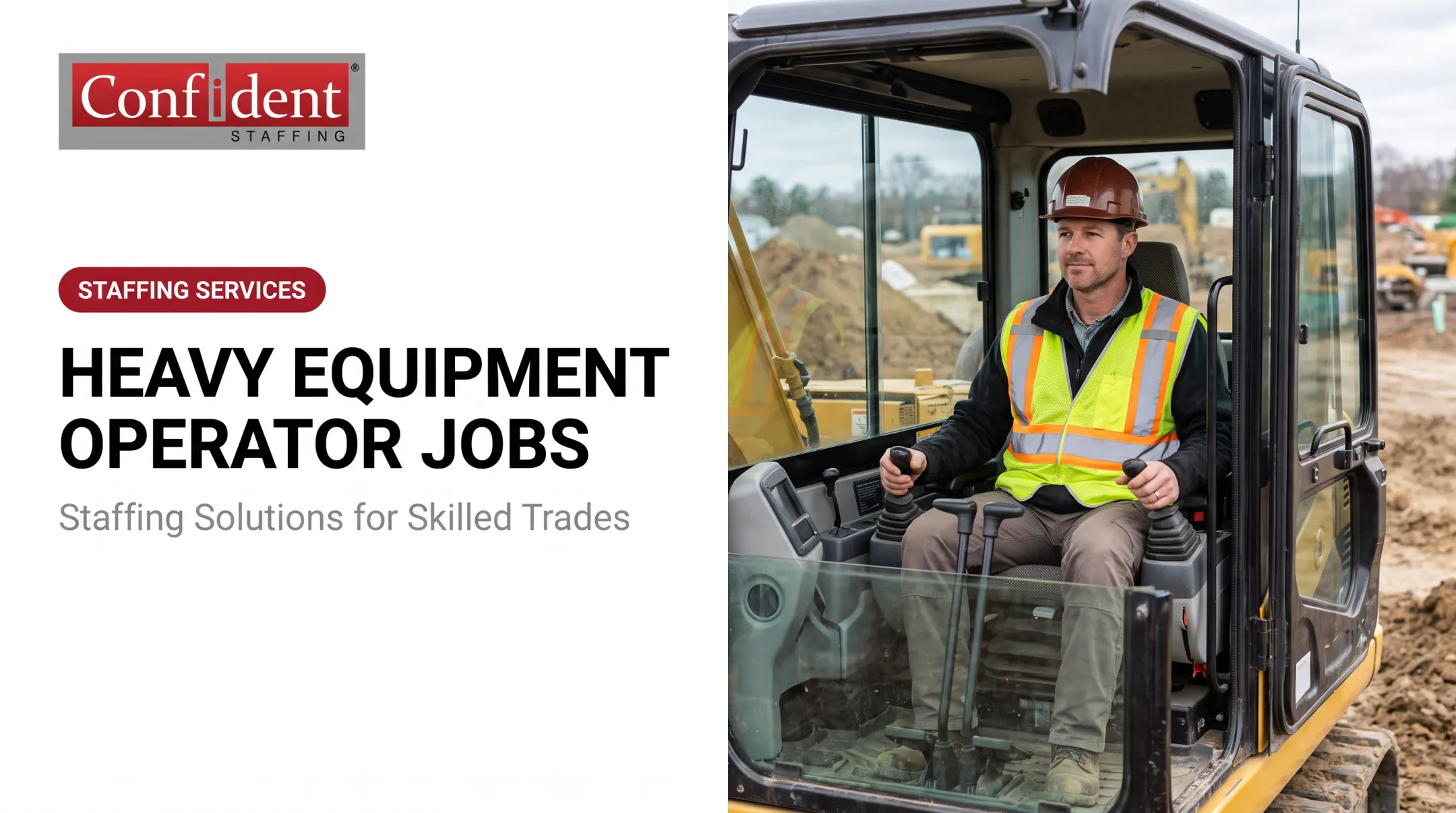

Here's the challenge. Job seekers want stable work that pays well without requiring a four-year degree. Meanwhile, employers keep struggling to find candidates who show up, learn fast, and stay. Both sides are looking for the same match, they just can't always find each other.
This guide breaks down what machine operators actually do, the different types of roles out there, what it takes to get hired, and what you can expect to earn. We'll also cover how a staffing partner like Confident Staffing helps job seekers and employers connect faster.
Key Takeaways
- Machine operators set up, run, monitor, and maintain equipment to keep production lines moving safely
- Entry usually needs only a high school diploma; skills build through on-the-job training
- CNC and other specialized operator roles typically pay more than general production work
- Operators can advance into lead operator, supervisor, or maintenance technician roles
- A staffing partner can shorten time-to-hire for employers and open more openings for job seekers
What Is a Machine Operator?
A machine operator installs, runs, and maintains machinery used in manufacturing and production settings. That's the short version. The real job involves setting up equipment before a run starts, watching output closely, adjusting settings when quality drifts, and shutting everything down safely at the end of a shift.
Operators are often the first people to notice something's wrong with a machine. It might be a strange vibration, a slight change in sound, or a part that's not quite lining up. That early detection matters because catching a problem early keeps a whole production line from grinding to a halt.
You'll see this role advertised under different titles depending on the employer. These titles often describe overlapping work:
- Production operator
- Manufacturing operative
- Machine operator
The core function stays the same: keeping equipment running and product quality consistent.
What Does a Machine Operator Do? Core Responsibilities
The daily work varies by industry, but most machine operator jobs share a common structure. Here's what a typical shift involves:
- Setting up and calibrating machinery before a production run begins
- Loading materials and monitoring equipment continuously throughout the shift
- Performing routine maintenance and basic troubleshooting when something goes wrong
- Inspecting finished products for quality control and documenting any defects
- Recording production data and flagging issues to supervisors right away
- Following safety protocols and keeping the work area clean and hazard-free Safety is built into every step above. An operator who skips a calibration check or ignores a maintenance flag risks defective product and serious injury.

Why the Details Matter
Small deviations compound fast on a production line. A machine running half a degree off temperature, or a blade that's slightly dull, can turn into hundreds of defective units before anyone notices. Operators who catch these issues early save their employers real money and downtime.
Types of Machine Operators
"Machine operator" is really an umbrella term. The specific machine, industry, and skill level all shape what the job looks like day to day.
Common roles include:
- CNC machine operators: Run computer-controlled equipment that cuts, shapes, and finishes metal or plastic parts, often reading blueprints and taking precise measurements
- Production and assembly line operators: Keep goods moving through standardized manufacturing processes
- Packaging machine operators: Handle equipment that preps products for shipment, including sorting, weighing, and sealing
- Forklift and heavy equipment operators: Move materials through a facility, feeding production lines and clearing finished goods
- Food processing operators: Run mixing, cooking, or batching equipment under strict sanitation standards and document each step for quality compliance

Skills often transfer between these categories. Someone who's run a packaging line can usually pick up production-line work quickly. That flexibility opens doors across manufacturing, aviation, construction, and light industrial sectors.
Machine Operator Requirements: Skills and Education
Most machine operator jobs don't require a college degree. A high school diploma or equivalent, plus a willingness to learn, is enough to qualify for most entry-level roles. The rest comes from on-the-job training.
Skills employers actually look for:
- Attention to detail (missing a defect costs money)
- Mechanical aptitude and basic troubleshooting instincts
- Physical stamina for standing and lifting through a shift
- Safety consciousness, without exception
Certifications aren't always mandatory, but they help. A CNC credential or forklift certification can boost both pay and job prospects, especially for operators trying to move into more specialized roles. Prior manufacturing experience is a plus for hiring managers, but it's rarely a dealbreaker for entry-level positions.
The demand backing this up is significant. BLS projects roughly 867,700 openings per year in production occupations through 2035, driven mostly by workers retiring or leaving the field rather than job growth. For qualified candidates, that turnover means consistent openings; for employers, it means ongoing competition for reliable operators.
Machine Operator Salary and Career Advancement
Pay varies a lot depending on the specific machine and specialization. According to O*NET's 2025 national wage data, general production workers earn a median of around $40,110 annually, while CNC tool operators earn a median of roughly $50,870.
Top-end pay tends to concentrate in specialized, technical roles. The 90th percentile for CNC operators reached $66,970 annually in the most recent BLS benchmark data.

What drives pay differences:
- Experience level (entry-level vs. seasoned operators)
- Geographic location and local cost of living
- Technical specialization, especially CNC or robotics work
Career growth follows a clear path for operators who keep building skills:
- Entry-level operator learning the basics on one machine type
- Lead operator, taking on setup responsibility and mentoring newer hires
- Supervisor or quality control inspector, overseeing broader production quality
- Maintenance technician, specializing in keeping equipment running

Factory jobs that pay well often combine two things: specialized machinery skills and leadership responsibility. Operators who invest in both tend to see the fastest wage growth.
How Confident Staffing Helps You Find Machine Operator Opportunities or Talent
Finding the right machine operator role, or the right candidate, takes more than scrolling job boards. Confident Staffing has been matching people to manufacturing and light-industrial positions in Oregon and Washington since 2002, with additional reach through nationwide direct-hire recruiting.
We regularly place candidates in roles such as:
- CNC operators
- Machinists
- Assemblers
- Welders
- General production workers
Every candidate completes an application and screening process before we send a resume to a client, so employers spend less time sorting through unqualified applicants.
For job seekers, our temp-to-hire model lets you start in a facility, prove yourself, and potentially convert to a permanent role without either side committing on day one. When a permanent hire is the goal from the start, we also handle direct-hire placement.
For employers, we fill machine operator openings on temporary, temp-to-hire, or direct-hire terms with candidates screened for the role and your team culture.
Ready to move forward? Job seekers can browse current openings on our job board, and employers can request a free staffing quote to get started.
Frequently Asked Questions
What is the average salary for a machine operator?
It depends heavily on the specific role. General production workers earn a median around $40,110 annually, while CNC operators earn closer to $50,690. Location and experience shift these numbers significantly.
What is the highest salary of a CNC operator?
Recent BLS benchmark data puts the 90th percentile for CNC operators at roughly $66,970 annually. Actual top pay varies by employer, region, and shift.
What does a machine operator do in a factory?
A machine operator sets up equipment, monitors production runs, checks output for quality issues, and performs basic maintenance. They also document production data and report problems to supervisors.
What qualifications do you need to be a machine operator?
Most roles only require a high school diploma or equivalent, with skills learned through on-the-job training. Certifications like CNC or forklift credentials aren't always required but can improve pay and job prospects.
Is machine operator a hard job?
The work is physically demanding, with standing, lifting, and repetitive motion throughout a shift. The learning curve is manageable, and clear paths exist toward higher pay and leadership roles.
How do you describe a machine operator on a resume?
Focus on the specific machinery you operated, quality control results you contributed to, your safety record, and any measurable production metrics. Specifics beat generic descriptions every time.